
Part 5 of 10 in 'The Case for Automation in IVF'. This week we look at IVF's most delicate procedure, the injection of egg with sperm, and what changes when automation replaces a trained hand.
Which ICSI method provides more consistent outcomes with verified completion?
A.) Manual ICSI, where a trained embryologist controls penetration angle, injection force, and confirms sperm delivery by visual judgement in real time
B. ) Automation-assisted ICSI with piezo-assisted membrane penetration, controlled depth, and computer vision verification of sperm deposition
Cast your vote. We'll return to this question at the end.
Intracytoplasmic sperm injection, or ICSI (pronounced "ick-see"), is one of the most technically demanding procedures in reproductive medicine. An embryologist sits at a specialised microscope, uses glass needles finer than a human hair to select a single sperm, immobilise it, and inject it directly into a mature egg. The target is a cell roughly 0.1 millimetres across, invisible to the naked eye. Success depends on precise control of angle, force, and depth, adjusted in real time by the practitioner's judgement.
Today, most IVF cycles worldwide involve ICSI. And for over thirty years, essentially every injection has been performed by a human hand. That is starting to change.
Why ICSI Matters, and Why It's So Difficult to Standardize
ICSI was developed to address cases where sperm cannot fertilize an egg on its own, including severe male infertility, previous failed fertilization attempts, or situations where only surgically retrieved sperm is available. Rather than hoping sperm will find and penetrate an egg in a dish, ICSI delivers fertilization directly: one sperm, one egg, one controlled injection.
The results transformed IVF outcomes. Fertilization rates that were previously unpredictable became much more consistent. Since its first successful use in 1992, it has become the dominant fertilization method in IVF. Today, ICSI accounts for the majority of IVF treatments carried out in developed countries. It is estimated the approach is used in 80% of IVF treatments in the US.
But ICSI carries a catch that is rarely discussed outside laboratory walls. The procedure is almost entirely dependent on the skill and consistency of the individual embryologist performing it. The Vienna Consensus, the authoritative performance standard for IVF laboratories, sets the acceptable rate of oocyte damage during ICSI at no more than 10%, with best practice defined as 5% or below 1. Those figures reflect the fact that the procedure does carry real risk of harm to the egg, and that risk is directly tied to how the injection is performed.
Two embryologists performing ICSI at the same clinic, using the same equipment and the same media, can produce measurably different outcomes (cite). The same embryologist can produce variable results depending on the position of a particular egg, or the quality of a particular batch of needles, or equipment calibration. These are not criticisms of individual practitioners. They are inherent features of any manual procedure where the instrument is a glass needle and the target is to capture the smallest human cell (the sperm cell).
The Case for Piezo-ICSI
Before we get to automation, it is worth understanding a variation on the standard technique that is already reshaping how injections are performed.
In conventional ICSI, the embryologist uses suction from within the needle to rupture the egg's inner membrane (the oolema) before depositing the sperm. This momentary aspiration of cytoplasm, the fluid inside the cell, is what confirms the membrane has been breached. It works reliably, but the technique demands significant skill and places mechanical stress on the egg.
Piezo-ICSI uses a different approach. A tiny electrical pulse sends a controlled vibration along the injection needle, allowing it to pass through the egg's membranes without the need for cytoplasmic aspiration. The needle penetrates, the sperm is deposited, the needle withdraws. The egg experiences much less mechanical disturbance.
The evidence for piezo-ICSI is accumulating. A prospective study by Zander-Fox and colleagues (2021), the first conducted outside Japan and at a centre with no prior piezo experience, found that piezo-ICSI produced a fertilization rate of 80.5% compared with 65.8% for conventional ICSI (adjusted model, p < 0.0001). Oocyte degeneration fell from 8.6% to 4.4%. Perhaps most importantly for patients, the number of embryos available for transfer or freezing increased by roughly one per cycle on average.
A previous study by Furuhashi and colleagues (2019) used a sibling-oocyte design, dividing eggs from the same patients between piezo and conventional ICSI, which elegantly removes patient-level variables. In women over 35, piezo-ICSI produced a fertilization rate of 74.8% versus 64.3% for conventional injection, and significantly higher blastocyst formation at day five or six (52.4% versus 39.6%). In women under 35, results were equivalent, suggesting piezo's advantage is most pronounced when egg quality is already under pressure from age.
The reason piezo-ICSI has had limited uptake for years is partly the use of mercury inside the needle as a damping fluid, which created occupational health and embryotoxicity concerns. Modern protocols now use medical-grade alternatives including perfluoro-n-octane, a compound already approved for ophthalmic use, which resolves that barrier. Damping-fluid-free approaches are also being developed.
Where Automation Enters
Piezo-ICSI has one feature that makes it particularly well suited to automation: the moment of membrane penetration is triggered by a programmable electrical pulse rather than by tactile judgement. That single change transforms the most difficult sub-task in ICSI, the one hardest to teach and hardest to replicate mechanically, into something that a computer can initiate with precise, reproducible parameters.
This insight is at the heart of what Conceivable Life Sciences has built with the C:ICSI module, part of AURA, its automation-assisted IVF laboratory.
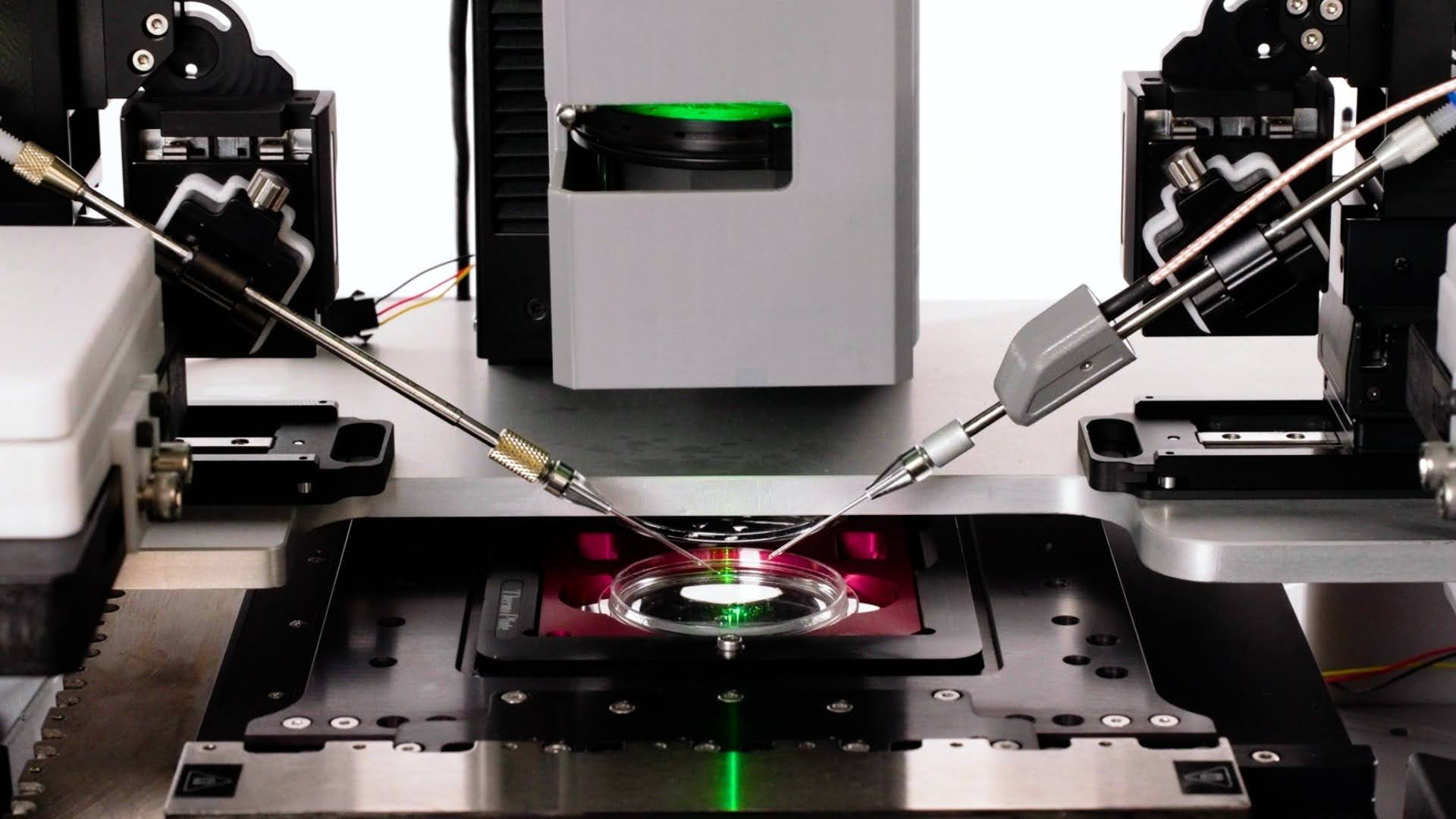
A landmark proof-of-concept study by Mendizabal-Ruiz and colleagues 5, published in Reproductive BioMedicine Online and awarded the Robert G. Edwards Prize Paper Award 2025 by RBMO in recognition of its significance, demonstrated that a fully automated, remotely operated system could execute all 23 micromanipulation steps of ICSI. The system achieved 80% fertilization from the five eggs it injected, comparable with 100% from the three manual controls. A frozen embryo transfer from the automated group resulted in a healthy baby boy.
The operator who guided most of the remote steps was located in Hudson, New York. The eggs were in Guadalajara, Mexico. The distance between them was approximately 3,700 kilometres [related blog].
What AURA's Automation-assisted ICSI Actually Does
Understanding why this matters requires a closer look at what the AURA system does at each stage of the injection, because the innovation is not simply that a machine holds the needle.
Sperm selection and identification. The system uses a computer vision tool to identify sperm cells in real time [as we discuss here], ranking them based on movement patterns associated with developmental potential. The selected sperm is tracked as it moves, and the system centres it in the microscope's field of view automatically.
Laser immobilization. Rather than manually immobilizing the sperm by bending its tail with the needle, the system fires a calibrated laser pulse at the midpoint of the sperm's tail. This is precise, repeatable, and leaves the sperm head undamaged (Ebner 2002) 6.
Oocyte positioning and zona penetration. Computer vision identifies the egg at multiple magnifications and aligns the tools (the holding pipette and injection needle). The piezo pulse, with controlled amplitude and frequency, then drives the needle through the zona pellucida (the egg's outer shell) and the oolema with defined depth parameters.
Verification of sperm deposition and oocyte integrity. This is perhaps the most significant quality assurance advance. In manual ICSI, successful injection is confirmed by the embryologist's visual impression during the procedure. AURA's system uses computer vision to verify that the sperm has been deposited inside the egg, and separately confirms that the egg has survived the injection intact. This creates objective, documentable evidence for each injection.
A study published in Human Reproduction by Chavez-Badiola and colleagues, placed ICSI within a full day automation sequence 7. Across 11 patients treated, the automated pathway achieved 64.3% fertilization and 42.2% usable blastocyst formation. Five healthy babies were born from nine patients with positive pregnancy tests. The Chief Editor of Fertility & Sterility has described this as a turning point in the history of IVF lab automation (Paulson 2026) 8.
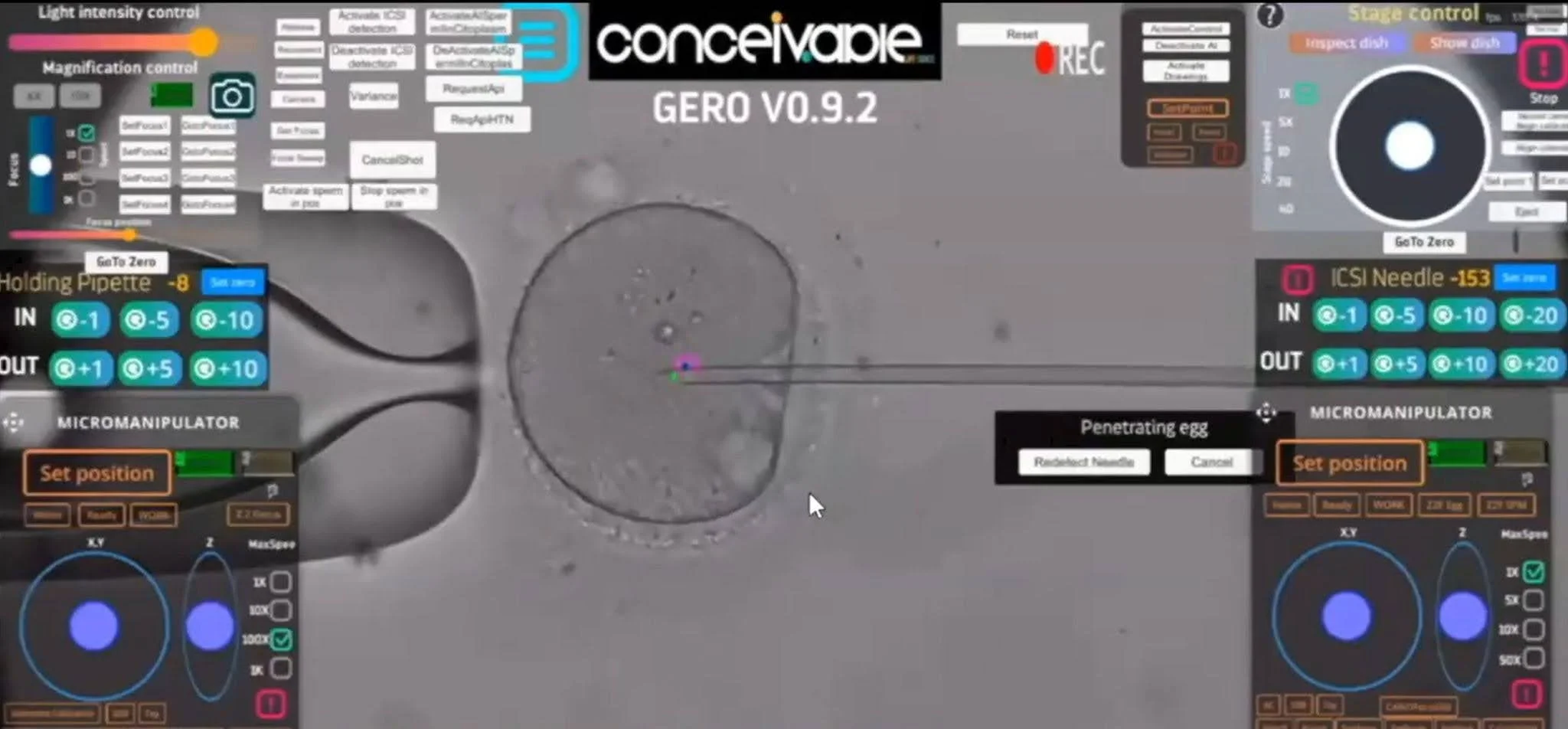
Piezo-ICSI performed with automation-assistance. A software interface controls injection speed and recognises the egg, the sperm cell, and the micromanipulation tools. Individual steps are monitored and recorded (image credit Mendizabal-Ruiz 2025)
What Automation Cannot Yet Replace
It is important to be clear about the current state of the technology. In the Mendizabal-Ruiz study, the automated system completed 49.6% of the required micromanipulation steps independently. The remainder were completed under digital control by the remote operator. Each injection took an average of nearly ten minutes, considerably longer than manual ICSI in routine clinical use.
In the full day automation sequence study, operators needed to intervene during egg handling and ICSI approximately a third of the time. The vision system occasionally misidentified a structure; an egg might require repositioning; cumulus cells sometimes required manual removal despite enzymatic treatment.
These are the honest limitations of a technology still in its early clinical phase. They also represent a clear roadmap for where engineering effort is now focused, including higher autonomy rates, faster cycle times, and expanded training datasets across patient populations and clinical settings.
The current system removes the subjective element from the moment of membrane penetration. The piezo pulse fires at defined parameters. The depth is controlled. The verification is machine-generated. Those properties do not depend on experience, shift length, or the particular difficulty of one patient's eggs.
Why Standardisation Matters Beyond Individual Clinics
There are around 2,900 IVF clinics operating in the United States alone, and many more globally. Their outcomes vary considerably, shaped by local embryologist experience, equipment, culture media, and protocols. A patient undergoing IVF at a top-tier academic centre has access to capabilities that a patient in a rural area or a lower-income country may not.
Automation addresses this asymmetry in two ways. First, a standardized automated system performs each step within defined parameters regardless of where the equipment is installed, which removes the ceiling on how consistently a less-experienced clinic can perform. Second, as the remote ICSI demonstration showed, expert oversight can be extended across distance, allowing a specialist to supervise or intervene from anywhere with a stable internet connection.
The clinical relationship between patients and their care team remains central. What changes is this: the quality of a specific technical procedure, the injection of a single sperm into a single egg, no longer depends on whether the best embryologist in the country happens to be at work that morning.
Returning to the Poll
Which ICSI method provides more consistent outcomes with verified completion?
A.) Manual ICSI, relying on practitioner skill for injection force, angle, and real-time visual confirmation
B.) Automated-assisted ICSI with piezo-assisted membrane penetration, controlled depth, and computer vision verification
Based on the evidence discussed here, the answer is B, with an important nuance. First-generation automation-assisted prototypes have not yet matched skilled embryologists on fertilization and blastocyst rates. . What they have demonstrated, consistently and documentably, is standardised execution of the injection itself: a controlled piezo pulse, defined depth parameters instead of visual estimation, and automated confirmation of sperm deposition.
Five babies born from a proof-of-concept study, and one from the remote ICSI study, are proof that automated systems can safely participate in clinical IVF pathways. The next chapter, underway now through the expanded AURA clinical trials, is establishing how consistently and at what scale that participation can occur.
-
E.S.I.G. and Alpha Scientists in Reproductive Medicine, 2017. The Vienna consensus: report of an expert meeting on the development of ART laboratory performance indicators. Reproductive BioMedicine Online, 35(5), pp.494-510.
Tiegs, A.W. and Scott, R.T., 2020. Evaluation of fertilization, usable blastocyst development and sustained implantation rates according to intracytoplasmic sperm injection operator experience. Reproductive BioMedicine Online, 41(1), pp.19-27.
Zander-Fox, D., Lam, K., Pacella-Ince, L., Tully, C., Hamilton, H., Hiraoka, K., McPherson, N.O. and Tremellen, K., 2021. PIEZO-ICSI increases fertilization rates compared with standard ICSI: a prospective cohort study. Reproductive biomedicine online, 43(3), pp.404-412.
Furuhashi, K., Saeki, Y., Enatsu, N., Iwasaki, T., Ito, K., Mizusawa, Y., Matsumoto, Y., Kokeguchi, S. and Shiotani, M., 2019. Piezo‐assisted ICSI improves fertilization and blastocyst development rates compared with conventional ICSI in women aged more than 35 years. Reproductive Medicine and Biology, 18(4), pp.357-361.
Mendizabal-Ruiz, G., Chavez-Badiola, A., Hernández-Morales, E., Valencia-Murillo, R., Ocegueda-Hernández, V., Costa-Borges, N., Mestres, E., Acacio, M., Matia-Algué, Q., Farías, A.F.S. and Carreon, D.S.M., 2025. A digitally controlled, remotely operated ICSI system: case report of the first live birth. Reproductive BioMedicine Online, 50(5), p.104943.
Ebner, T., Moser, M., Yaman, C., Sommergruber, M. and Tews, G., 2002. Successful birth after laser assisted immobilization of spermatozoa before intracytoplasmic injection. Fertility and sterility, 78(2), pp.417-418.
Chavez-Badiola, A., Mendizabal-Ruiz, G., Flores-Saiffe Farías, A., Costa-Borges, N., Murray, A., Alikani, M., Silvestri, G., Millan, C., Hernández-Morales, E., Valencia-Murillo, R. and Medina, V., 2026. Automated oocyte retrieval, denudation, sperm preparation, and ICSI in the IVF laboratory: a proof-of-concept study and report of the first live births. Human Reproduction, 41(2), pp.214-230.
Paulson, R.J., 2026. Automation in the gamete laboratory: have we reached a turning point?. F&S Reports, 7(3), pp.171-172.