
Can a Fertility Procedure Be Performed from 3,700 Kilometres Away?
A healthy baby boy proves remote ICSI is possible. And he's just made scientific history.
In 2024, a healthy baby was born after a fertility treatment in Guadalajara, Mexico. On the surface, this sounds like an everyday event at any fertility clinic around the world. Yet this particular birth was anything but ordinary. His conception was guided in part by an operator sitting in Hudson, New York, nearly 3,700 kilometres from the lab where egg and sperm were brought together.
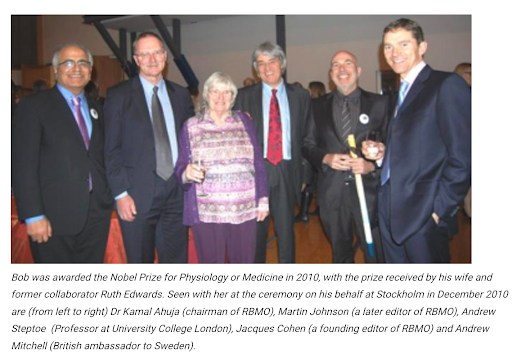
This remarkable story is the subject of a peer-reviewed paper that has just been awarded the RBMO Robert G. Edwards Prize Paper Award 2025 for the best paper published in this leading reproductive medicine journal. The prize honors the legacy of Sir Robert Edwards, the Nobel Prize-winning scientist who pioneered in vitro fertilisation (IVF) and helped bring the world's first IVF baby, Louise Brown, into existence in 1978 [read the full paper here].
So what exactly happened in that lab, and why does it matter for the future of fertility care?

A Closer Look at ICSI
To understand this breakthrough, we first need to talk about a technique called intracytoplasmic sperm injection, better known by its acronym, ICSI (pronounced "ick-see"). Since its first successful use in 1992, ICSI has become one of the most common methods of fertilising eggs during IVF treatment.
In a standard ICSI procedure, an embryologist uses a microscope and extremely fine glass needles to inject a single sperm directly into an egg. The task demands the same fine precision familiar to anyone who has ever threaded a needle. Now imagine that the needle is thinner than a human hair and the target is a single cell, invisible to the naked eye. The embryologist must hold the egg steady with one instrument while guiding the sperm-loaded needle with the other, piercing the egg's outer shell (the zona pellucida) and its delicate inner membrane before depositing the sperm inside.
It is painstaking work made possible by specialised tools. The success of the procedure depends heavily on the skill of the individual embryologist. Experience, fatigue, and simple human variability all play a role. This is where automation enters the picture.
Building a Robotic ICSI System
The research team behind this award-winning paper was led by Jacques Cohen, a pioneer in micromanipulation techniques and the embryologist who happened to take over Bob Edwards’ Bourne Hall lab (Cambridge, UK) before expanding his career in the US. The team set out to answer a deceptively simple question: could they build a system capable of performing every single micromanipulation step of ICSI, either autonomously or under digital control, while allowing a human operator to supervise and intervene remotely?
The answer, as the birth of that baby boy confirms, is yes.
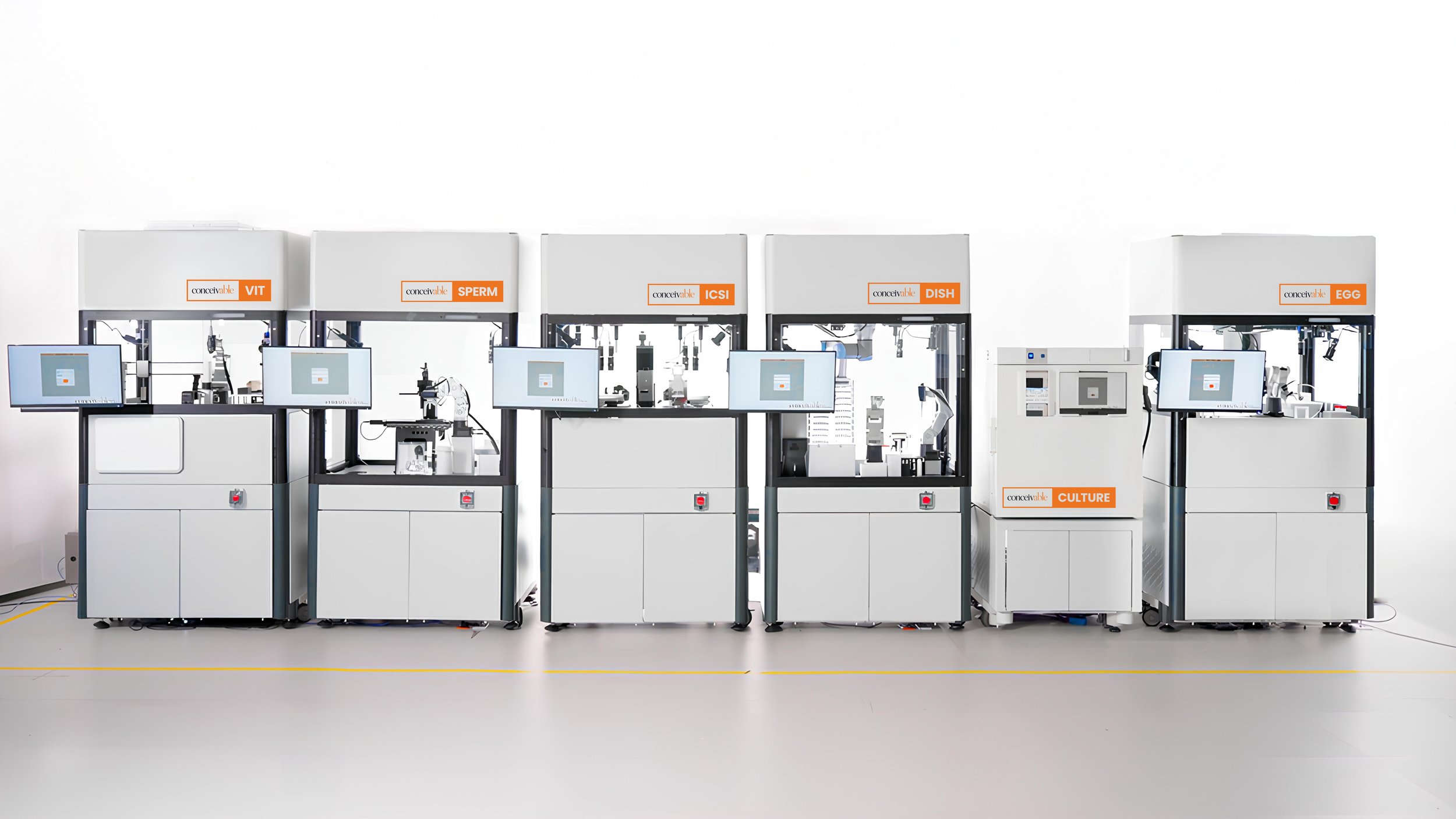
The automated ICSI system is built from components already familiar to embryologists: a specialised inverted microscope, a heated stage to maintain optimal cell temperature, and precision microinjectors. What distinguishes it is that these elements now operate through motorised controls, high-definition cameras for real-time visualisation, and AI-driven oversight.
Think of it as a highly sophisticated workstation where every knob and dial has been replaced by software commands.
The system breaks down the ICSI procedure into 23 distinct micromanipulation steps. These include locating and selecting a sperm cell, immobilising it, loading it into the injection needle, positioning the egg, piercing the egg’s membrane using tiny, controlled vibrations, and finally depositing the sperm inside the egg. Each step can be triggered by a digital command issued through a computer interface, either by someone in the same room or by someone on the other side of the world with a decent internet connection.
The Role of Artificial Intelligence in IVF
One of the standout features of this system is its use of artificial intelligence. The team employed an AI called SiD, originally developed to help embryologists select the best sperm for injection. SiD analyses sperm cells in real time, ranking them based on movement patterns which are associated with healthy development. The system then tracks the selected sperm as it moves, centres it in the microscope's field of view, and fires a laser pulse to immobilise it precisely at the midpoint of its tail.
Additional AI systems handle other tasks like identifying the egg at different magnifications, determining where to position the holding pipette and injection needle, and tracking the location of instruments throughout the procedure. One of the most crucial branches of AI used here is Computer Vision. It allows the machines to interpret images, enabling the system to "see" what it is doing and make adjustments on the fly.
This is not science fiction. This is assisted reproductive technology now.
From Mouse Models to Human Treatment
Before any of this technology was used on human eggs, the team conducted extensive preclinical testing. They used mouse models to optimize the laser settings for sperm immobilisation and to confirm that the method was safe. The results were reassuring: fertilisation rates, embryo development, and live birth rates were all comparable to those achieved with conventional mechanical methods. Mice born from the laser-immobilised sperm showed normal health, behaviour, and fertility across two generations.
The team also tested the remote-operator system using hamster eggs and human sperm, a well-established model for evaluating ICSI technique. The findings were once again reassuring.
With these safety data in hand, and after obtaining ethical approval from an independent review board, the team moved to a clinical pilot study.
The Case That Made History
The patient was a 40-year-old woman with diminished ovarian reserve, a condition in which the number of eggs remaining in the ovaries is lower than expected for her age. She and her partner, a 43-year-old man with moderate sperm abnormalities, had already experienced one failed IVF cycle. They were referred for treatment using donor eggs.
The remote ICSI procedure was directed by operators located both in a room adjacent to the laboratory and in Hudson, New York. On site specialists remained on standby, ready to take over should there be any unexpected issues.
Of the five eggs injected under remote control using ICSI, four fertilised normally, an 80 percent success rate. Three eggs injected manually following the standard approach fertilised as well. In the end, each group (digital control and manual ICSI) produced two embryos suitable for transfer. The first attempt, using a fresh embryo from the ICSI group, did not lead to a pregnancy. A later attempt, using a frozen and thawed embryo from the same group, did. The pregnancy unfolded without complications, and a healthy baby boy was delivered by elective C-section at 38 weeks, weighing 3.3 kilograms.
What This Means for the Future of Fertility Treatment
It is important to keep this achievement in perspective. This was a single case, a proof of concept rather than a large-scale clinical trial. The procedure took almost ten minutes per egg, considerably longer than manual ICSI, and required more human operators than would be practical in routine clinical use. There is still work to be done before systems like this become standard equipment in fertility clinics.
But the implications are significant. IVF automation has the potential to reduce variability between operators and clinics, standardising outcomes for patients no matter where they seek treatment. Remote operation could allow expert embryologists to supervise or assist procedures at clinics in underserved regions, expanding access to high-quality fertility care. And by reducing the repetitive, physically demanding aspects of micromanipulation, automation could help address burnout among laboratory professionals.
The system also highlights how AI in IVF is moving beyond image analysis and into active procedural assistance. Sperm selection, instrument tracking, and cell segmentation are no longer solely dependent on human eyes and hands.
A Milestone Worth Celebrating
The RBMO Robert G. Edwards Prize Paper Award 2025 recognises research that advances the field of reproductive medicine in meaningful ways. This paper, authored by a large international team spanning institutions in the United States, Mexico, and Spain, represents exactly that kind of contribution. It demonstrates that robotic fertility treatment is not a distant prospect but a present reality, one that has already resulted in a healthy child.
As with any emerging technology, questions remain. How will regulators approach automated systems that make decisions traditionally left to clinicians? How will patients feel about having their treatment overseen from thousands of kilometres away? And can these systems adapt to the countless small variations that embryologists encounter daily?
These are conversations worth having. For now, though, there is a baby in Mexico whose birth suggests that the future of fertility technology is closer than we might have imagined.
Where We Are Now
Today, Conceivable Life Sciences has moved beyond early proof-of-concept research and is actively advancing its AI-powered automated IVF platform, AURA. The company has raised a $50 million Series A round, bringing its total funding to about $70 million to date, with capital earmarked for further development of the technology and a planned U.S. commercial launch in 2026. AURA is currently operational in a clinical setting in Mexico City, where it is integrated into a 125-patient IRB-approved pilot study that builds on earlier prototype use and early pregnancy outcomes. This phase of work reflects the company’s dual focus on rigorous validation and practical deployment, as it continues collaborating with fertility patients, clinicians, industry partners, and regulators to ensure that automated IVF can deliver greater consistency, scalability, and accessibility without compromising safety or expert oversight.
Read the full paper and explore more breakthrough work pushing IVF science forward here.
This blog post discusses research published in Reproductive BioMedicine Online. The study was conducted at Hope IVF Mexico with technology developed by Conceivable Life Sciences. For readers interested in learning more about IVF, ICSI, and emerging embryology innovations, we encourage you to explore reputable sources such as the Human Fertilisation and Embryology Authority (HFEA) and the American Society for Reproductive Medicine (ASRM).