
Millan et al., Fertility and Sterility, 2024
Objective
To evaluate the performance of a robotic system for semen preparation.
Materials and Methods
We developed a robot capable of precise pipetting to carry out direct vertical swim-up (DSU) autonomously with a single command. During robotic DSU, 0.5mL of the raw ejaculate is overlaid with medium and incubated at room temperature for 20 min. The robot was preclinically evaluated using 12 donor samples, aiming to recover a seminal plasma-free preparation without washing (centrifugation), and achieve a concentration of ≥100 progressively motile sperm/μL, which would allow ICSI. A semi-quantitative immunochromatographic test was performed on the final suspension to detect Prostate-Specific Antigen (PSA) as a marker of seminal plasma contamination. On completion of preclinical testing, robotic DSU was evaluated in a pilot clinical study (NCT06074835, ClinicalTrials.gov; IRB registry CONBIOÉTICA-09-EIC-00120170131, study RA-2023-01) where the prepared semen was employed in three ICSI cycles.
Results
During preclinical testing, the mean volume, concentration, and % progressive motility for 12 normozoospermic samples were, respectively, 3.0mL (±1.0), 87.8 x 10ˆ6/mL (±42.8), and 46.3% (±8.8). The motile sperm recovery target was met in all 12 preparations. PSA concentration was less than 50μg/mL in all cases. Clinical results are presented in Table 1. Four blastocyst transfers following ICSI with robotically prepared sperm resulted in one ongoing pregnancy.
Conclusions
This is the first report of a fully automated, precision pipetting semen preparation robot that obviates the need for manual sperm washing, centrifugation and microfluidic devices. Future iterations will improve the robot’s ability to handle samples with abnormal parameters (e.g. severe oligo- or asthenozoospermia).
Impact Statement
This is the first report of a fully automated, precision pipetting semen preparation robot that obviates the need for manual sperm washing, centrifugation and microfluidic devices. Future iterations will aim to improve the robot’s ability to handle semen samples with severely abnormal parameters (e.g. severe oligo- or asthenozoospermia).
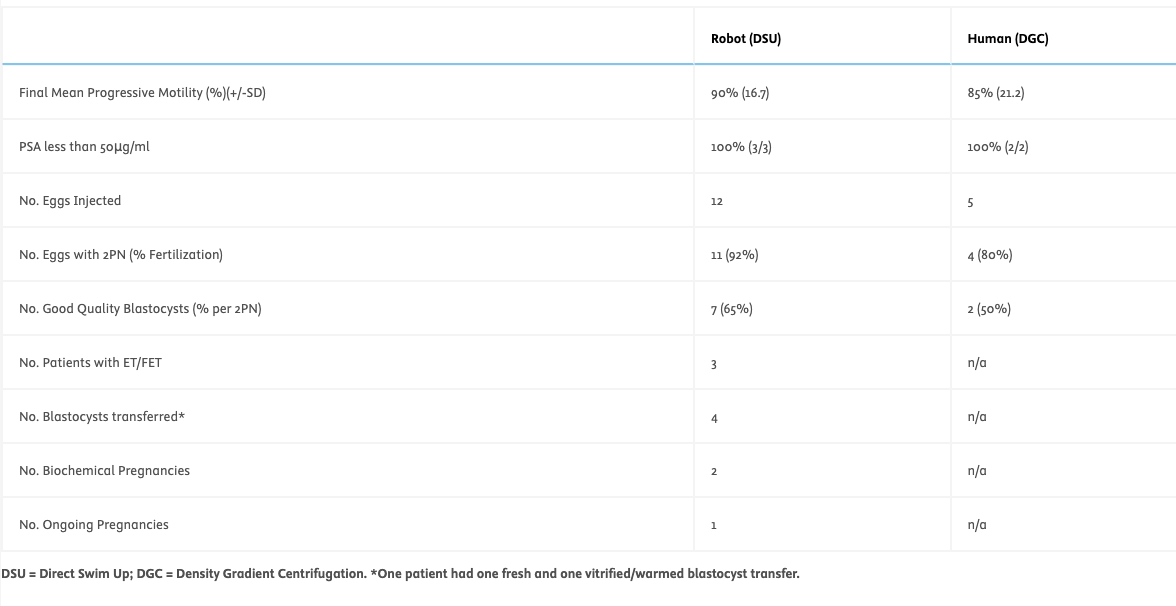
Table 1.
Comparison of prepared sperm parameters and ICSI outcomes between robotic-assisted and traditional semen preparation in pilot clinical trial.
DSU = Direct Swim Up; DGC = Density Gradient Centrifugation. *One patient had one fresh and one vitrified/warmed blastocyst transfer.
Support
The experiments presented in this abstract were fully sponsored by Conceivable Life Sciences.