
Flores-Saiffe Farias et al., Fertility and Sterility, 2024
Objective
Evaluate an AI-driven robotic oocyte retrieval and denudation system.
Materials and Methods
We developed a system that incorporates AI for cumulus-oocyte complexes (COCs) identification and precise robotic pipetting for COC isolation from follicular fluid and denudation pre-ICSI. System functionality was validated in an animal model and evaluated in a pilot sibling oocyte study in six IVF patients (NCT06074835 ClinicalTrials.gov; IRB registry CONBIOÉTICA-09-EIC-00120170131, study RA-2023-01). Follicular aspirations were randomly assigned to either robotic or manual COC search followed by denudation. When the robot failed, an embryologist intervened and completed the step, reassigning the COC/oocyte to the manual group. ICSI, culture and vitrification was performed manually as routine.s.
Results
AI detected 90% (46/51) of COCs in the aspirates; the remaining were recovered by an embryologist. The system autonomously pipetted 55-83% of the COCs and the remaining were pipetted under digital control. The robotic system pipetted from dish to dish and between different media droplets. Ninety percent of the oocytes were successfully denuded by the robot, without observable damage to the oocytes. Average times taken were: 59s/COC for scanning the follicular fluid and pipetting the COCs to another dish, 107s/COC for washing, and 9.2min/COC for denudation (hyaluronidase exposure, removal of corona cells, washing/transfer, one COC at a time).
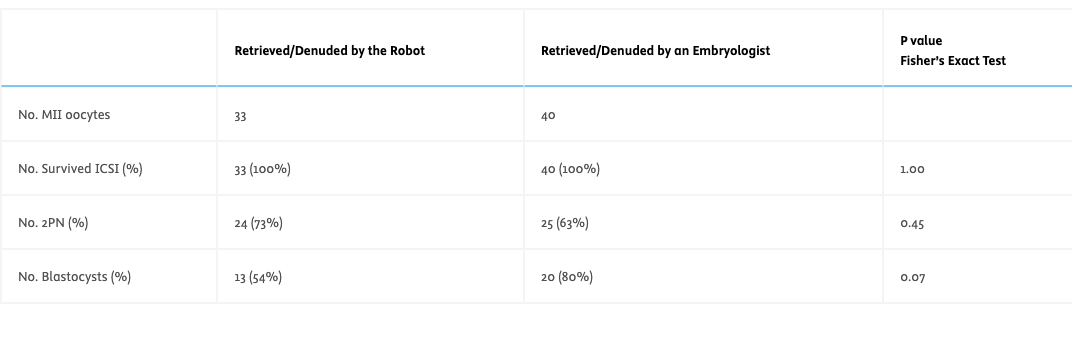
Laboratory outcomes for 33 MII oocytes retrieved and denuded by the robotic system and 40 sibling MII oocytes handled by an embryologist are shown in Table 1. Single vitrified/warmed blastocysts from robotically handled oocytes were transferred in 3 patients, resulting in one ongoing pregnancy, one positive beta hCG and one result is pending at the time of writing
Conclusions
We provided proof of the concept that oocyte identification, isolation and denudation can be performed by an AI-powered robot while maintaining integrity and development potential of the oocytes. The current system’s efficiency is low and needs to be improved. COC identification is expected to improve iteratively as the AI gains more exposure to retrieval procedures. The results support further development and application of this system.
Impact Statement
Our system is consistent and precise in methodology but has not reached the level of a skilled embryologist. Nonetheless, the results represent an important step toward automation in the IVF laboratory and standardization, which can be expected to lead to better outcomes for patients.
Support
The experiments presented in this abstract were fully sponsored by Conceivable Life Sciences.