
IVF Lab Automation Achieves a First: Five Live Births from Robotic Systems
For the first time, robotic systems handled the most delicate IVF lab procedures in sequence — and five healthy babies were born. Here's how we pulled it off.
Somewhere in a fertility laboratory, a robotic arm dipped a pipette into a dish of follicular fluid. Computer vision scanned the murky liquid, identified a cluster of cells containing a human egg, and guided the system to aspirate it with precise, measured suction. The egg was transferred to a clean solution, stripped of its surrounding cells, and prepared for fertilization.
A second system had already processed the sperm. A third would perform the injection.
Months later, a healthy baby was born. Then another. Then three more.
A proof-of-concept study published in Human Reproduction reports the first live births from IVF cycles where multiple robotic systems handled critical laboratory procedures in sequence. The technology worked. But what exactly does that mean, and why was this a scientific milestone?
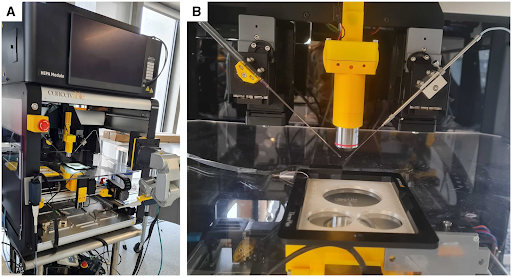
Figure 1 - 2023 First Gen prototype. Conceivable’s automated systems utilise robotic arms to directly manipulate sperm and eggs within an enclosed and controlled environment.
A) Automation prototype during final assembly and quality control.
B) Movable stage with microscope objective and end effector capillaries.
A Fifty-Year Bottleneck: Why IVF Lab Automation Took So Long
When Louise Brown was born in 1978, the first baby conceived through IVF, the laboratory work was intensive but small-scale. A team of three had spent over a decade on the problem, attempting nearly 280 embryo transfers before succeeding. Today, over 430,000 IVF cycles are performed annually in the United States alone. The science scaled. The laboratory work mostly didn't.
Blood labs automated decades ago. So did pathology. But IVF has remained stubbornly manual, and for reasons worth understanding.
On retrieval day, what clinics call "Day 0," embryologists manage a cascade of time-sensitive tasks. Eggs arrive bathed in follicular fluid, wrapped in layers of cells. Each must be found, isolated, cleaned, and prepared. Sperm must be processed and selected. For ICSI cycles, a single sperm gets injected into each egg under a microscope using glass needles finer than a human hair. Multiple patients' samples may move through the lab simultaneously. There's little room to pause.
The difficulty isn't precision alone. It's variability. Eggs don't behave identically. A cumulus mass that should aspirate cleanly sometimes doesn't. Sperm can move unpredictably or be hard to find. Embryologists navigate these situations through pattern recognition built over thousands of cases, adjusting technique in ways they might struggle to articulate. This kind of tacit expertise is exactly what machines find hardest to replicate.
So when Conceivable Life Sciences set out to automate Day 0 IVF procedures, they weren't solving one problem. They were confronting dozens of tightly coupled tasks, each with its own constraints. The team's approach was focused. They didn't try to build a system that runs unsupervised from start to finish. Instead, they asked a narrower question: which specific tasks can machines handle reliably, and where must humans remain in the loop? The goal was not to prove superiority over manual techniques — but to establish feasibility.
How Conceivable Built Its Robotic IVF Systems
Conceivable built three separate robotic platforms nicknamed “Pearls”, each focused on a distinct part of the workflow.
Pearl 1 prepares sperm. In one configuration, it layers sperm-friendly solution over a semen sample and waits while healthy sperm swim upward, then collects them. In another, it creates a network of tiny connected droplets, essentially a microscale maze that only motile sperm can navigate. AI monitors when enough have reached the endpoint.
Pearl 2 handles eggs. It uses computer vision to identify egg-containing cell clusters, and transfer them to clean dishes. It then assists with stripping away the cumulus cells that surround each egg.
Pearl 3 performs ICSI. AI helps select a suitable sperm. A laser immobilizes it. The system positions the egg and injects the sperm using tiny vibrations that allow the needle to enter with less cellular stress.
A “String of Pearls” in practice meant that eggs and sperm from the same patient passed through two or three of these systems sequentially during a single IVF cycle. Other eggs from the same patient were handled manually, using the same protocols, media, and culture conditions.
Between April and October 2024, Conceivable treated 11 patients at HOPE IVF in Guadalajara, Mexico, using its newly developed String of Pearls approach.
IVF Automation Results: Fertilization, Blastocysts, and Live Births
The “String of Pearls” pathway achieved 64.3% fertilization and 42.2% blastocyst formation. The manual pathway, using sibling eggs from the same patients, achieved 81% and 59.6%.
Experienced embryologists outperformed the prototypes. That shouldn't be surprising for first-generation technology tested against skilled professionals. Both sets of laboratory metrics, automated and manual, fell within established competency benchmarks.
The automated systems demonstrated viability. Embryos created through the robotic workflow implanted successfully and developed normally. Twelve were transferred. Nine patients became pregnant. Five delivered healthy babies, with three biochemical pregnancies and one early loss. These outcomes are aligned with expectations in IVF care.
Where Robotic IVF Systems Performed — and Where They Needed Help
Not all tasks responded equally well to automation.
Sperm preparation ran smoothly. Once initiated, the system completed its work without intervention. An embryologist could walk away and return to a finished sample. This makes intuitive sense: the procedure follows defined steps with measurable outcomes. Count motile sperm at the end, and you know whether it worked.
Egg handling and injection were more variable. Operators needed to step in and take manual control roughly a third of the time. Sometimes the vision system misidentified a structure in the fluid. Sometimes an egg oriented awkwardly and needed repositioning before injection. Sometimes cells clung stubbornly after enzymatic treatment and required manual removal.
These interventions might sound like setbacks. They're better understood as the system recognizing the limits of its own competence. The machine handles routine cases. When biology throws a curveball, the embryologist catches it..
The fact that some tasks achieved full autonomy while others required frequent intervention is informative. It reveals where current technical limits lie and which steps need refinement; constraints measured in real clinical use rather than theory.
What This IVF Automation Study Doesn't Yet Answer
This pilot answered one question—can it work?—but left many others open. The study involved 11 patients at a single clinic, most using donor eggs and mild stimulation protocols. The most challenging cases—severe male factor infertility, surgical sperm retrieval, prior fertilization failure—were deliberately excluded. How these systems perform across broader patient populations, more complex clinical scenarios, and different laboratory environments has not yet been tested.
Reproducibility is another open question. The systems were operated by a team deeply familiar with their design. Whether other laboratories can achieve comparable results, train staff effectively, and troubleshoot independently remains to be demonstrated.
Many of the proposed benefits of automated embryology lie in reducing variability, fatigue-related errors, and protocol drift. This study was not designed to measure those effects, and whether partial automation improves consistency and safety in routine clinical practice or scales efficiently across different settings, remains unknown.
Finally, while five healthy live births provide reassurance about immediate safety, long-term developmental outcomes and cumulative pregnancy rates across all cryopreserved embryos are not yet known. Those answers will emerge only with time and larger cohorts.
Why These Five Births Are a Milestone for IVF Lab Automation
Before this study, sequential automation of Day 0 IVF procedures existed as engineering demonstrations and conference presentations. What hadn't been shown was whether embryos created this way could become healthy children.
Now we know they can.
The prototype Pearl systems have since been retired. But the lessons they generated didn't stop with them — they informed the development of AURA, Conceivable's next-generation automation platform, currently undergoing expanded clinical trials across multiple sites. The work continues: broader patient populations, higher autonomy, deeper validation.
The foundational question, whether machines can safely participate in creating human embryos, has an affirmative answer. For IVF laboratories facing workforce constraints and rising caseloads, that's a door opening. Walking through it responsibly will take careful work. But the threshold has been crossed.
Five families have new children. The science moves forward. And a question that once seemed speculative now has data behind it.
This blog post summarizes findings from "Automated oocyte retrieval, denudation, sperm preparation, and ICSI in the IVF laboratory: a proof-of-concept study and report of the first live births," published in Human Reproduction (2026). The study was sponsored by Conceivable Life Sciences; author disclosures are detailed in the publication.