
Centrifuge-Free Sperm Preparation: How C:SPERM Selects by Motion, Not Force.
The Case for Automated IVF: A Series Detailing a New Standard of Care
Swim, Not Spin: Centrifuge-Free Selection for Healthy Sperm
Miti Saksena, MBBS, MSc
Crossposted from https://conceivablelifesciences.substack.com/
Which sperm preparation method best preserves sperm motility and eliminates contaminants?
A. Centrifugation-based protocols, where sperm is spun 2 cycles at 300-500g
OR
B. Centrifuge-free dish-based separation, where sperm select themselves by swimming, leaving everything else behind
Nature has its own method for selecting the strongest sperm: swimming. Only motile sperm reach the egg. Everything else falls away. In most manual IVF labs, the process of sperm selection by swimming is replaced by a process that uses a centrifuge, where the whole ejaculate is spun at force. The spin damages healthy sperm before the embryologist ever touches the sample.
By the time a sperm is picked for injection (in ICSI for example), the harm could already be done at the molecular level — and no selection under a microscope can see it. Automation-assisted sperm preparation removes the centrifuge from the equation: motile healthy sperm gently migrate, leaving contaminants behind by design.
The Problem : The Method Damages What It Is Meant to Protect
Sperm preparation in IVF relies on two techniques developed decades ago. Density gradient centrifugation pours the ejaculate onto layers of increasingly dense liquid and spins it — healthy sperm, dead cells, leukocytes, and debris all sinking at different rates, with the sperm fraction collecting at the bottom. Swim-up allows motile sperm to swim upward into clean medium, but usually only after the sample has already been centrifuged once. The damage precedes the selection.
When sperm is compressed under centrifugal force, leukocytes and dysfunctional sperm release reactive oxygen species — free radicals that attack the membranes of the healthy sperm beside them, stripping the lipids that protect the cell, breaking the DNA strands inside it, and degrading the mitochondria that power its movement [1]. The causality runs both ways: the dysfunctional cells cause damage, and the mechanical stress of centrifugation itself further impairs sperm function. The sperm that survives looks normal under a microscope. Its damage is invisible — and no selection at the injection dish can find it, because the harm is already done.
Centrifugation also incompletely removes biological contaminants. In the creation of the pellet, bacteria, immature germ cells, and inflammatory cells may be compressed alongside healthy sperm and remain in contact throughout a total preparation process of around 60 minutes [2]. Their concentration is reduced. They are not eliminated. Microbiological testing of semen samples confirms bacterial contamination is present in the vast majority of ejaculates before preparation — and persists in the processed fraction after centrifugation [3].
The Vienna Consensus — the authoritative performance standard for IVF laboratories — defines what good sperm preparation looks like: in an IVF-quality sample prepared by a skilled embryologist, ≥90% of recovered sperm should show progressive motility, with ≥95% as the aspirational benchmark [4]. These are the standards the best centrifugation-based labs reach on their best days. That means even at benchmark, up to 5% of the recovered fraction — the sperm that made it through preparation — are not progressively motile.
An alternative method has existed in the literature since 1995. The biological principle is straightforward: motile sperm self-select by swimming through dish-based environments (connected microdrops), self-washing free of seminal contaminants in the process [5, 6]. Direct comparative analysis has confirmed that this approach yields superior morphology, membrane integrity, vitality, and nuclear chromatin integrity compared to centrifugation-based methods [7]. What has kept it off the clinical floor is execution: preparing a network of precisely connected microdrops, is too labour-intensive and operator-dependent to run reliably across a busy clinical day [8]
Conceivable's Approach : Swim, Not Spin
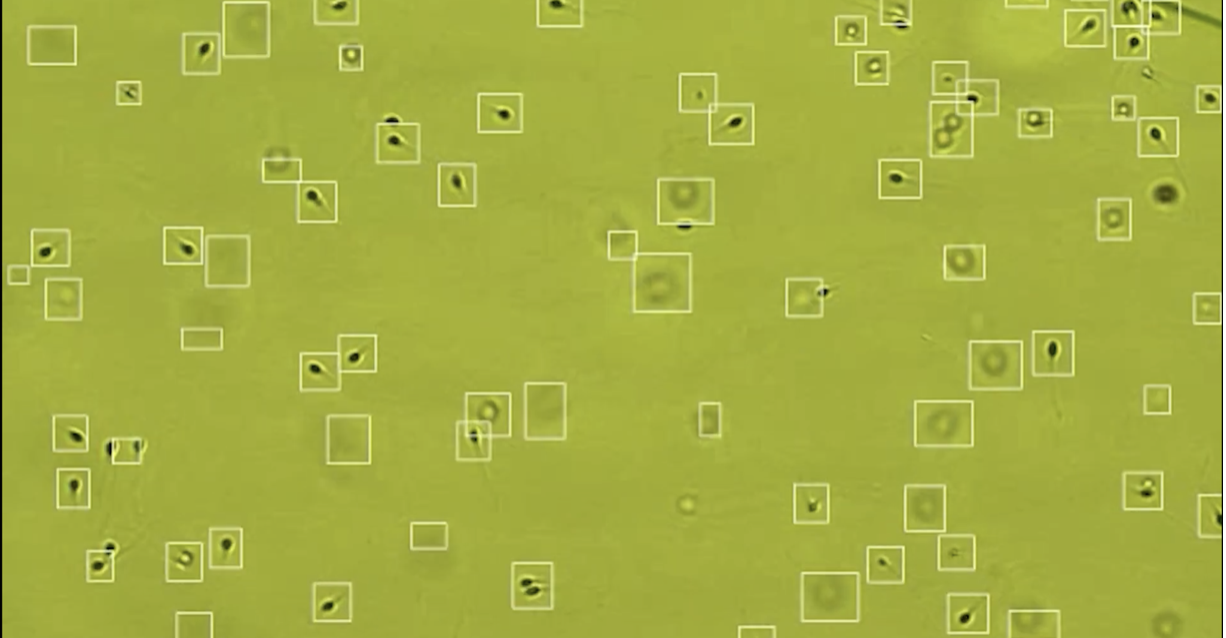
At Conceivable, we eliminated the centrifuge entirely. C:SPERM, the sperm preparation workstation within AURA, our automation-assisted IVF laboratory, works on a simple principle: motile sperm will swim forward through connected drops of culture medium under their own power; everything that cannot swim will not. The system loads a small amount of ejaculate into a starting drop, links it through a series of medium-filled channels to a clean collection drop, and uses a camera to watch in real time as sperm migrate across. When enough motile sperm have arrived in the collection drop, the system cuts the connection. What remains in the collection drop is a population of sperm cells selected entirely by the ability to swim — the same criterion nature uses — with no mechanical force applied. C:SPERM eliminates contamination entirely. Palini and colleagues confirmed this approach results in the complete absence of bacterial and pathogen contamination in the collection fraction — including in samples that tested positive for sexual pathogens before preparation [3], and our own testing could not identify any remaining trace of the seminal plasma protein PSA in the prepared sample.
The clinical evidence for this approach is independently validated. A randomized controlled trial of 1,034 ICSI cycles comparing dish-based horizontal migration against conventional swim-up found cleavage rates of 98.2% versus 92.1% (p=0.0003) and blastocyst rates of 48.1% versus 41.2% (p=0.001) in favor of the centrifuge-free method, with no significant difference in fertilization rate [2]. A multicentric study comparing dish-based preparation directly against density gradient centrifugation found blastocyst rates of 58.5% versus 41.7% (p=0.009) and clinical pregnancy rates of 41.9% versus 25.8% (p=0.045) [9].
A 2025 systematic review and meta-analysis of centrifuge-free microfluidic sperm selection, which shares C:SPERM's core principle of motility-based selection without centrifugation, confirmed significantly reduced sperm DNA fragmentation and improved reproductive outcomes versus standard methods across multiple independent datasets [10].
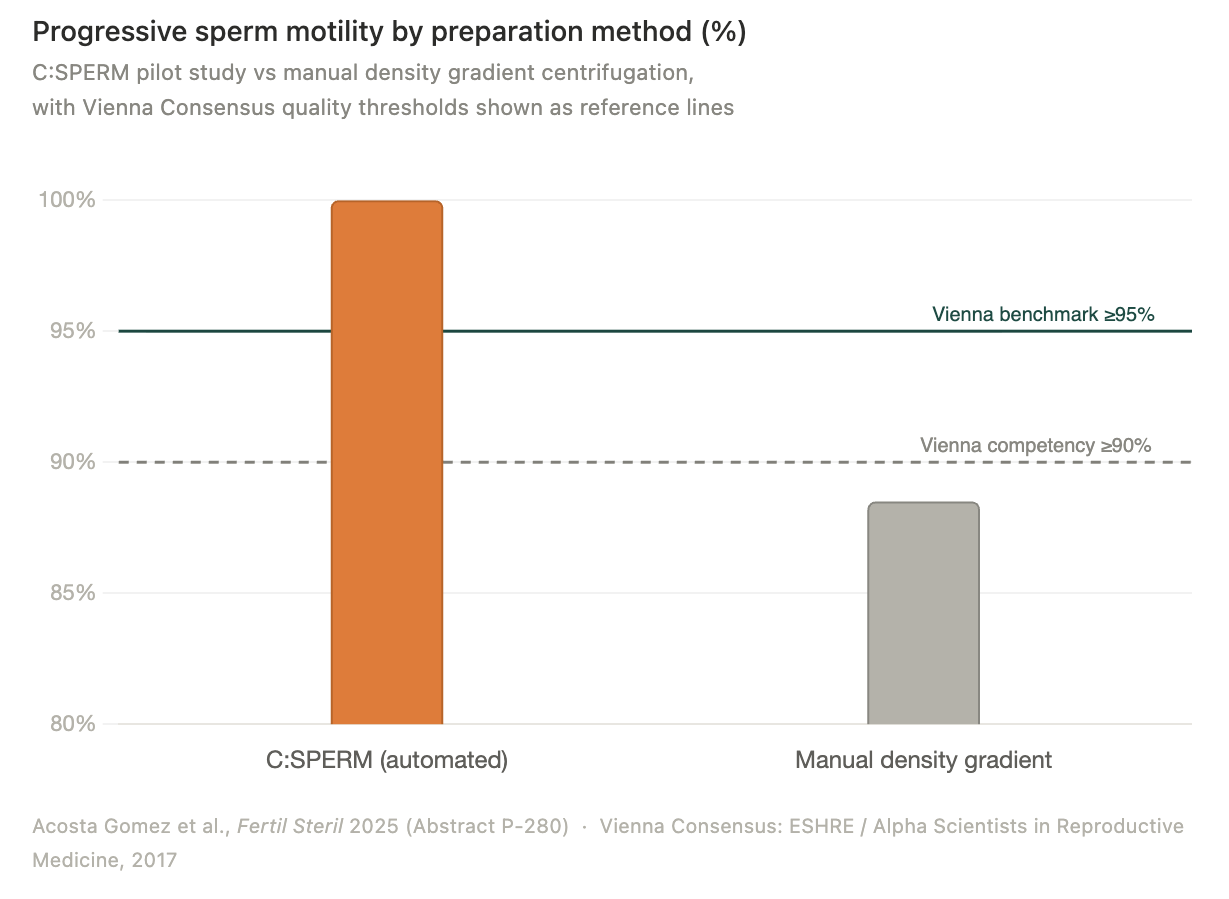
Our own clinical data confirms what the principle predicts. In a pilot study of C:SPERM across six ICSI cycles, biochemical testing confirmed that the sperm collected for injection were fully free of seminal plasma — the fluid that carries the contaminants and oxidative material centrifugation fails to eliminate. Progressive motility was 100% in the automation-assisted group, compared to 88.5% with manual density gradient preparation (p=0.06) — above both the Vienna Consensus competency threshold of ≥90% and the aspirational benchmark of ≥95%. Preparation time was 25 minutes versus 60 minutes manually. Seven single blastocyst transfers produced four ongoing pregnancies and three live births — the first babies born after automation-assisted dish-based sperm preparation [11].
The Implication
Fertilization rate is stable across preparation methods. What changes when the centrifuge is removed is everything downstream — cleavage, blastocyst development, pregnancy — the stages affected by sperm DNA integrity rather than motility alone [2, 3]. A prospective randomized trial of centrifuge-free microfluidic sperm preparation found improved blastocyst rates and a higher proportion of euploid embryos compared to density gradient centrifugation [12] — connecting sperm preparation directly to embryo chromosomal integrity, and to the outcomes that matter most at transfer. The patients who stand to gain most are those where that integrity is already compromised: male-factor infertility, elevated DNA fragmentation, poor previous cycles. These are the cases where centrifugation-induced damage compounds an existing vulnerability.
However, for samples with very low sperm concentration or severely compromised motility, centrifugation-based preparation remains necessary — a limitation Conceivable is actively working to address through automation-assisted approaches tailored to these cases.
The centrifuge has been the default not because it is the best method for sperm — but because it was practical. C:SPERM changes that: the preparation that protects sperm is now the preparation that scales.
The Answer to the Quiz:
Which sperm preparation best method preserves sperm motility and eliminates contaminants?
A. Centrifugation-based protocols, where sperm is spun at 2-3 cycles at 300-500g
✅ B. Centrifuge-free dish-based separation, where sperm select themselves by swimming, leaving everything else behind
Centrifuge-free preparation can outperform centrifugation on blastocyst development, pregnancy rates, and sperm DNA integrity — outcomes with real clinical impact. The damage centrifugation causes happens before selection begins, and no microscopic assessment can find it afterward. Removing the centrifuge means the sperm arriving at injection is genuinely healthier, not just apparently so.
However, when sperm concentration or motility is critically low, there simply aren't enough swimming sperm to select from — and centrifugation remains a necessary tool. For most cases, though, the evidence is clear: swim, don't spin.
-
Aitken RJ, Clarkson JS. Significance of reactive oxygen species and antioxidants in defining the efficacy of sperm preparation techniques. J Androl. 1988;9(6):367–376.
Baldini D, Baldini A, Silvestris E, et al. A fast and safe technique for sperm preparation in ICSI treatments within a randomized controlled trial (RCT). Reprod Biol Endocrinol. 2020;18:88.
Palini S, Primiterra M, De Stefani S, et al. A new micro swim-up procedure for sperm preparation in ICSI treatments: preliminary microbiological testing. JBRA Assist Reprod. 2016;20(3):94–98.
ESHRE Special Interest Group of Embryology and Alpha Scientists in Reproductive Medicine. The Vienna consensus: report of an expert meeting on the development of ART laboratory performance indicators. Reprod BioMed Online. 2017;35(5):494–510.
Gordon JW, Chen HL. Penetration of hamster oocytes by human sperm in an in vitro fertilization microchamber after insemination with unprocessed semen. Fertil Steril. 1995;64(2):437–440.
Hossain AM, Barik S, Rizk B, et al. Analysis of in vitro migration patterns of human spermatozoa by a Petri dish-based horizontal column. Biol Reprod. 1999;61(2):406–410.
Hinting A, Lunardhi H. Better sperm selection for intracytoplasmic sperm injection with the side migration technique. Andrologia. 2001;33(6):343–346.
Baldini D, Ferri D, Baldini GM, et al. Sperm selection for ICSI: Do we have a winner? Cells. 2021;10(12):3566.
Palini S, De Stefani S, Primiterra M, et al. Comparison of in vitro fertilization outcomes in ICSI cycles after human sperm preparation by density gradient centrifugation and direct micro swim-up without centrifugation. JBRA Assist Reprod. 2017;21(2):89–93.
Gisbert Iranzo A, Cano-Extremera M, Hervás I, et al. Sperm selection using microfluidic techniques significantly decreases sperm DNA fragmentation, enhancing reproductive outcomes: a systematic review and meta-analysis. Biology. 2025;14(7):792.
Acosta Gomez FJ, Aleriano K, Barragan CP, et al. Pilot clinical evaluation of an automatic horizontal sperm swim-out method for semen preparation. Fertil Steril. 2025;124(Suppl). [Abstract P-280]
Godiwala P, Kwieraga J, Almanza E, et al. The impact of microfluidics sperm processing on blastocyst euploidy rates compared with density gradient centrifugation: a sibling oocyte double-blinded prospective randomized clinical trial. Fertil Steril. 2024;122(1):85–94.