
Empowering Embryologists Through Automation:Elevating IVF Care with Consistency and Compassion
Automation in IVF empowers embryologists to perform at their best—every patient, every time. Conceivable’s AURA system standardizes care and reduces fatigue, without replacing expertise.
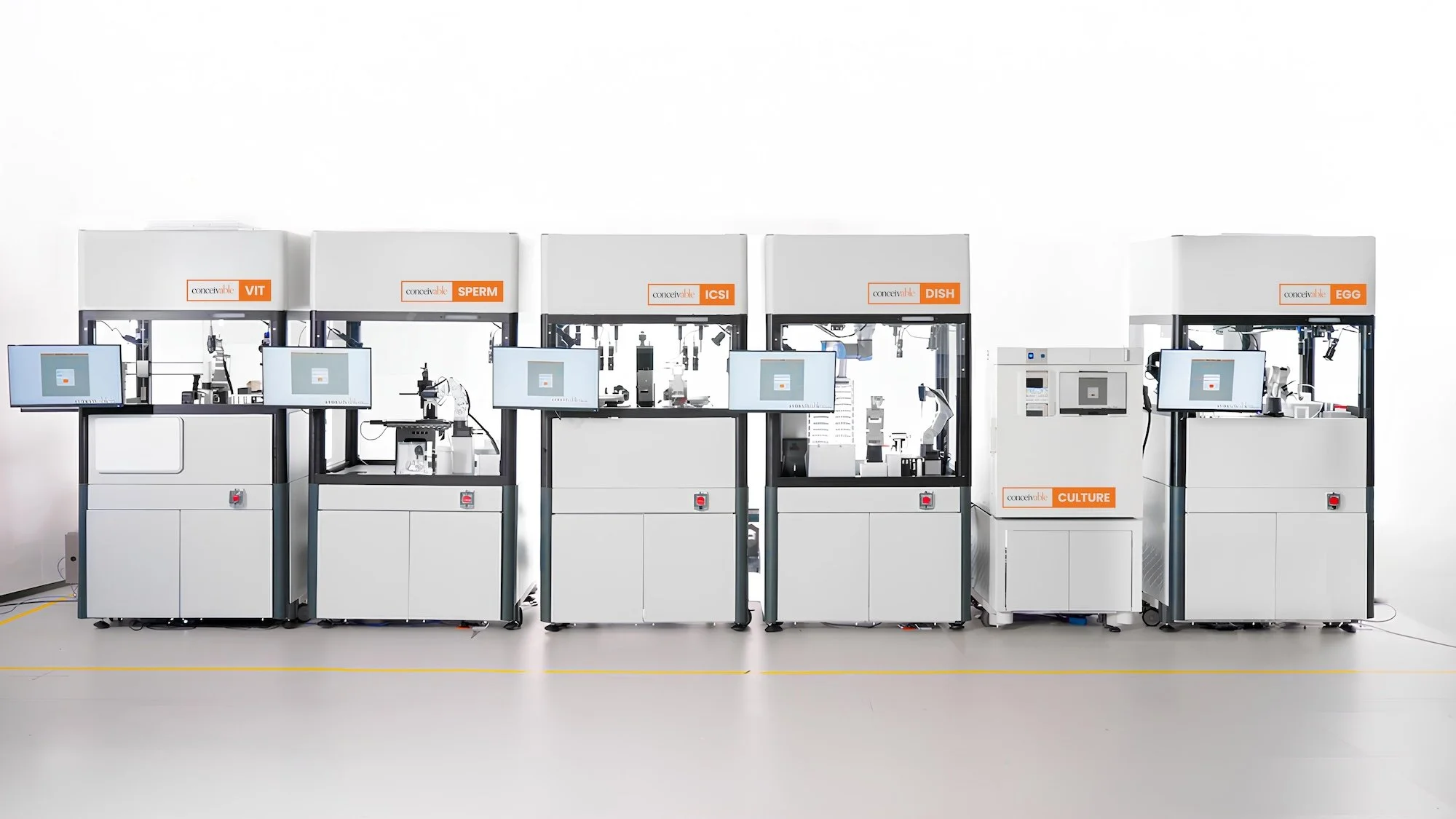
AURA, the AI-powered, automated IVF laboratory
In the world of in vitro fertilization (IVF), every detail matters. Every moment of focus, every micromovement under the microscope, every decision made in the embryology lab can shape the future of a hopeful family.
But embryologists are human. They carry both remarkable skill and real-world limitations—see the Journal of Assisted Reproduction paper that called embryologist burnout “a silent saboteur in in vitro fertilization laboratories” and documents occupational stressors around fatigue, cognitive load, and the natural variability that comes with a highly complex workday. What happens when the same pair of hands that starts the day with precision and energy becomes strained by the dozens of procedures completed hours later?
It’s a question Conceivable Life Sciences’ Chief Medical Officer, Dr. Alejandro Chavez-Badiola, posed recently:
“Which embryologist are you today? The focused, energized version of yourself at 8 a.m.? Or the fatigued version by 3 p.m., after a dozen complex procedures?”
The Real-World Challenge: Variability in the IVF Lab
Embryologists often perform dozens of procedures in a day, such as Intracytoplasmic Sperm Injection (ICSI)—essentially single cell surgery that requires a delicate, high-skill process that requires total precision. But like any human expert, performance can fluctuate throughout the day, and this variability can influence outcomes.
In a field where patients invest their hopes, emotions, and resources into a single cycle, consistency isn't just ideal—it’s essential.
Automation as a Partner, Not a Replacement
Conceivable has built a different kind of solution: AURA, our end-to-end AI-powered, automated IVF laboratory. And to be clear—AURA is designed to elevate embryologist expertise, removing the burden of repetitive, manual tasks, and ensuring that each patient benefits from the same standard of care. For example, Columbia University published a study on automated dish preparation that showed a greater than 10-fold improvement in consistency in preparing embryo culture dishes while maintaining optimal pH levels in the culture media. They also Increased the rate of embryo development that led to a higher number of usable embryos.
AURA uses integrated robotic systems, built to work together as a workcell, that perform key lab procedures with standardized precision and consistency. These include:
C: DISH – Automated dish preparation
C:SPERM – Automated sperm preparation
C:EGG – Automated oocyte handling
C:ICSI – Automated ICSI injection
C:VIT – Automated vitrification and thawing
C:HANDLER – Robotic transport between components
C:NEXUS – Our cloud-based software platform for orchestration, data collection, and real-time monitoring
Every AURA system is operated by a team of three humans—a senior embryologist, a lab technician, and an engineer—ensuring that expertise remains at the core of patient care.
What Happens When You “String the Pearls”
Through a process we call stringing the pearls, AURA integrates multiple workstations to perform the more than 200 steps required to create an embryo—streamlining workflows and reducing manual handoffs that often introduce variability. For example, by connecting C:SPERM, C:EGG, and C:ICSI workstations, embryologists can automate sequential steps of a single IVF cycle while maintaining full oversight. This integration ensures each patient's cells receive the same level of care and precision, regardless of when procedures occur.
This is not just a technological upgrade—it’s a paradigm shift. Automation doesn’t dilute or diminish the role of the embryologist; it enhances it. By allowing skilled professionals to delegate time-consuming, repetitive tasks to reliable automated systems, they’re free to focus on the critical moments that require nuanced judgment and human empathy, not to mention create an opportunity to scale a Nobel Prize-winning therapy for millions without access.
The Emotional Layer: IVF Is Deeply Personal
Behind every IVF cycle is people—individuals, couples, families, communitiies—dreaming of building a family. Patients may not know the technical terms or processes behind their care, but they deserve to feel confident that their cells are treated with the utmost precision throughout the IVF process.
Automation in IVF allows clinics to deliver on that promise. By standardizing IVF and ensuring that whether a process begins at 7 a.m. or 3 p.m., the same focus, attention, and technological precision is executed.
Reducing Burnout and Building Sustainable Labs
There’s another vital benefit to automation: supporting the people who make IVF possible. The IVF field is experiencing growing demand, yet labs are often short-staffed and overworked (see this MIT Technology Review story about the embryologist shortage). According to the International Committee for Monitoring Assisted Reproductive Technologies, global demand for IVF has increased steadily, creating pressure on clinics and providers.
AURA helps address this challenge by:
Reducing workload strain on embryologists
Decreasing error risk due to fatigue or time pressure
Enhancing lab throughput without compromising quality
Enabling more sustainable work environments for skilled professionals
Ultimately, better-supported embryologists provide better care—day after day, patient after patient.
Reimagining the Future of Fertility Care
The question Dr. Alejandro Chavez-Badiola posed—Which embryologist are you today?—does more than highlight a challenge. It reveals a vision: one where the best version of an embryologist is available to every patient, every time. Where technology enhances, not replaces, human expertise. And where automated IVF becomes synonymous with consistent, compassionate, high-quality fertility care.
At Conceivable, we believe this vision is not just possible—it’s already happening.
As our IRB-approved studies progress and the data continues to support AURA’s ability to meet industry benchmarks (including those set by the Vienna Consensus), we are building a future where automated systems don’t replace the human touch—they enable it to flourish.